Posts

Showing posts with the label Archaeology

Arroyo Negro Pueblo: In My Backyard

Image
For several years, I tried to pin down the location of the site of a 1,000-year-old Pueblo village that was supposed to be near my home. Eventually I found it, just 600 feet from my backdoor, on top of the ridge that you see in the background of this photo. This view of the ridge that climbs about 100 feet above my house is looking from the rooftop of my house, and my neighbors' houses. This pueblo was first excavated by archaeologists in the 1920s, who named it the Arroyo Negro Pueblo. It is considered perhaps the best mapped, although least described, of the Santa Fe River pueblo sites from the Late Development period. Wood cores were taken from structural support timbers of the buildings in 1934 to do tree ring dating. The Ancestral Puebloans spent 50 years constructing seven buildings up there, from the years 1050 to 1100. The buildings consisted of anywhere from 2 to 25 rooms. Alongside most of the buildings, on the side facing the Santa Fe River, was a round, free-stand...
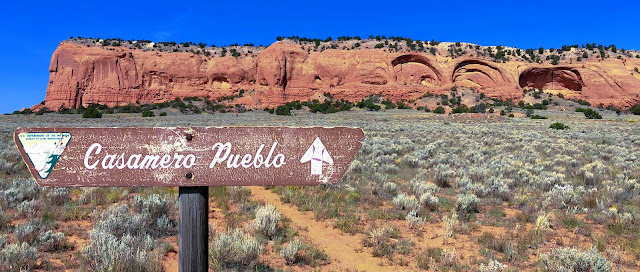
Casamero Pueblo: Caught in the Owl's Eyes Gaze

Image
Casamero Pueblo is a Chacoan outlier Great House site located between Grants and Gallup, NM. This two-story Great House was occupied between A.D. 1000 and 1125. It had 22 ground floor rooms and may have had six second-story rooms. It is located 45 miles south of Chaco Canyon, making it a Chacoan outlier community. You can see its walls in the far distance, to the right of the sign, at the base of the bright red sandstone cliffs of Tecolote (Owl) Mesa. The two alcoves just to the right of the sign form the large "owl's eyes" that give the mesa its name. The Great House had T-shaped doorways that are characteristic of Chacoan architecture, one small interior kiva, a great kiva, and two Chacoan roads. Casamero was settled during a time that corresponded with a surge of building in Chaco Canyon – around A.D. 1050. It existed during much of the florescence of Ancestral Pueblo culture in Chaco Canyon, was clearly related to it, and declined in unison with it. When something in...

Following Ancient Footsteps from Otowi Mesa to Otowi Pueblo

Image
It was early September, the hottest day of the year, when we walked out onto Otowi Mesa , a finger of a ridge that points east from Los Alamos toward the Rio Grande Rift Valley. You can see the valley in the background where a thin blue layer of smoke from forest fires was settling and the temperature was hovering around 100 – it was about 10 degrees cooler up here. Zooming in on the smoke settling in the valley: the mesas in the foreground are where thick layers of volcanic tuff that form the Pajarito Plateau have resisted more than one million years of erosion, which carved down the land surrounding them, forming canyons.  On the horizon, the Sangre de Cristo mountain range is the east edge of the Rio Grande Rift valley.   Below here, Otowi mesa becomes a narrow spine of rock extending off the left side of this photo for several miles.  The same view of Otowi Mesa five months later as the sun was setting on a snowy February day. We literally followed in the foo...

The Earliest Evidence of Basketmakers in the Southwest: Falls Creek Valley

Image
Looking across the Animas River Valley, north of Durango, Colorado, to the white, banded cliffs that are above the Falls Creek Valley. In the background are the La Plata mountains with early Spring snow.  These cliffs are designated the Falls Creek Archaeological Area because some of the first dwellings built by Basketmaker people in the Southwest were discovered here. There were dwellings inside rock overhangs at the base of those cliffs and on the slopes below. The rock shelters and caves in these cliffs were first lived in some 2,700 years ago, at the end of the Archaic and beginning of the Basketmaker period. They remained occupied until this region was vacated by Indigenous people around the year 825. People may have preferred to live high up on the side of the Falls Creek Valley because it was warmer there than on the valley bottoms, which collected colder air that tended to sink. These Basketmakers were among the first people in the Mesa Verde region to cultivate maize,...